Saturday, 15 October 2022

The Battle of St Brelade – Jersey Boys Part IV

‘Sergeant? Sergeant!?’

‘Sir.’

‘What is that infernal racket?’

‘I’m playing music, sir.’

‘Is that what you call it? What instrument is that?’

‘It’s a sort of a whistle, sir. It is in harmony.’

‘What with, for heaven’s sake, man? A banshee?’

‘No, sir. It is in harmony with itself, and the surroundings.’

‘Jersey?’

‘No, sir, not Specifically. I was thinking more of being alone on this weird island, miles from anywhere, with an enemy close by but invisible due to the fog, sir. So I was playing some music to cheer the men up.’

‘I think you have done that, sergeant, by stopping. Anyway, we are not alone. There are six companies of Hatter’s regiment here, all ready and raring to go at a moment’s notice.’

‘Yes, sir. Except for Captain Jeffrey’s company, who are having a nap.’

‘It has been a long and damp day, sergeant. Anyway, nothing has happened so far.’

‘It is very quiet, sir. Too quiet….’

*

As they say: famous last words. As anyone who has been following the invasion of Jersey will recall, the Parliamentarians stormed ashore at St Ouen’s beach this time. As the Royalists retreated (or ran for it) the invaders split into two forces, a central one, commanded by Colonel Harme with his own regiment (or the remaining eleven companies thereof, one company having been scattered on the beach). This one has struck inland towards St Peter’s, following the main retreating Royalist force. The other force, commanded by Major Scott has struck south with six companies of Hatter’s regiment with the idea of capturing St Brealdes and St Aubins, as neither of the militia companies from these parishes were present at the beach. However, due to circumstances beyond Major Scott’s control (i.e. bad dice throwing by yours truly), the southern advance has rather ground to a halt in mist and general bad weather.


The above shows the campaign map, with Hatter’s regiment and the St Brelade’s militia in the south-west of the island. The orange pin is a courier from Sir George Carter summoning the militia company to St Peter’s, where the yellow map pin is. That pin marks the dragoon company of the island garrison, and the green one next to it is four militia companies. Two more militia companies are forced marching there (St Aubin’s and St Lawrence’s). To the south, incidentally, you can see that the fleets are (just about) in contact although the wind is against the Royalists taking any action. This turn the weather has become light rain, so visibility is limited anyway.

The St Brelade’s militia is led by Captain Ralph LeDieu, a fairly courageous and enterprising sort of chap, who has decided that as the invaders are stationary and it is a bit misty, a surprise attack might be in order. And so a small game was born.


The militia is on the left here, and the camp of Hatter’s regiment is on the right. Dice rolling against the company commander’s initiative score indicated that only the company in white coats (they should all be red I know, but we’ve had to go for a bit of wargamer’s licence here) are not on alert. While visibility is two base widths it does not look that good for LeDieu’s man, although they do not know it yet.

Unfortunately, I did not get many decent pictures from the game, fairly short as it was. The militia met Scott’s own company (in brick red in the centre) and, after a bit of a serious fight, actually bested them. By that time, however, even Captain Jeffrey’s company had rallied, and the militia was under pressure.


I told you that the pictures were not that good. Still, the left-hand militia half-company is about to break, while the right-hand company will actually win its fight against the flankers, but then decide that withdrawing is the better part of valour. You can just see the remnants of Scott’s company departing on the right-hand side of the picture.

Under the campaign rules I am developing, incidentally, a company that routs during a wargame automatically disperses, which is why Harme’s regiment is missing a company which routed on the beach. Here, Scott’s company (both half-companies) have routed, so Hatter’s are down a company. The militia lost half a company routed, while LeDieu managed to bring off the other half. Dicing decided that the militia went home, having done their bit.

As a further aside on the rules, units which finish the game shaken or doubly shaken also dice with a risk of dispersing, so the Royalists actually lost an extra unit of militia above those who were routed on the beach, which is why they have no units in the north of the island. If you are wondering why the eastern militia units are not, apparently, doing anything, that is because Carter’s courier summoning them with all speed to St Peter’s went astray; I’ve adopted something along the lines of Henry Hyde’s courier rules, so they have an 80% chance of getting through. It had to be that one which failed, of course.

There are negotiations going on between the forces near St Peter’s. Carter was all set to surrender, but his captain of dragoons, Eric James threatened to arrest him unless the island forces resisted. He is now trying to spin the negotiations out until the reinforcements arrive.

In the aftermath of the St Brelade’s skirmish, Hatter’s have occupied the village and will set about advancing on St Aubin’s, which is undefended except for the garrison of St Aubin’s Tower (red pin). At sea I am not sure what is going to happen; a lot depends on the wind. The most advanced Parliamentarian ship is Tresco, a sixth rate, with the fleet not far behind, Behind them are two small merchants which are carrying the Parliamentary horse, looking for a safe harbour to land them. The rest of the merchant fleet has been sent to collect the Guernsey militia and should be back in two days or so.

*

‘Sergeant?’

‘Sir?’

‘If you play your whistle thing will my company return?’

‘I can’t, sir. It got broken in the excitement.’

‘We must praise the Lord for small mercies, sergeant.’


Saturday, 8 October 2022

Source for the Goose


It is all right. I have not lost my remaining marbles, I really do mean ‘source’. I have banged on before, I am sure, about the historical wargamer’s use of sources to inform their rules, army lists, and games. On the whole, I fear many wargamers, and not a few writers of popular history, are guilty of rather naive reading of what sources we have.

I am not saying that I am much better, of course. We have to treat our sources for warfare with respect. Whoever they were they probably had better access to information than we do. But that does not mean we should treat everything they say with unquestioning belief. As I am sure I have mentioned before, as wargamers we like some sort of firm knowledge about what happened, who was there, and in what numbers, and that information is rarely available to us.

The spark for this little rant has been starting Eleanor Parker’s new tome, which is titled ‘Conquered’, and is about the last generation of children born in Anglo-Saxon England, that is before the Norman conquest. Her argument is along the lines that what we have in the lives of heroes and saints, and the chroniclers, tell us rather more about the times of the writer rather than the times of the written about.

I suspect that this is rather generally true. After all, I think it is acknowledged that Tacitus, for example, rather wrote up the strength, virility, and vitality of the barbarians to contrast them with the effete, wealthy, and lazy Romans of his day. When a half-decent general arrived and put some discipline and backbone into the legions they put the enemy to flight with no problem at all. But the decent Roman commanders incurred the wrath of the useless and incompetent Emperors and were recalled, dismissed, and if they were lucky never commanded again. That is really making a point about the Emperors and those in Rome, not particularly about the commanders, perhaps.

Therefore, we have to be very careful with the sources that we read in order to glean anything about what happened in battles, campaigns, and politics of any particular time. We might think that an ancient source, or one contemporaneous with events, would be the most reliable. But that might be untrue; the source might be the most biased possible. Granted such sources can rarely change the outcomes of events, but they can emphasize or de-emphasize them, and distort the relations between actors in the story and events. As has been noted in popular psychology, people rarely distort the events, but they do distort their relation to the event (consider the difference between ‘The gun went off and he was hit’ and ‘I shot him’).

As the attentive reader of the blog might be aware, I dabble in little or no wargaming after about 1720 or so. The sources, even for events in the Seventeenth Century, can be a little dubious, not to say downright contradictory. I have little idea whether things improved after that. It is possible that they did, but I suspect that confidently bandied around paper strengths might have only a passing relationship with the truth. As a place to start they might be all right, but as soon as a battalion started to march my guess is that it started to lose strength.

Even if no one actually physically deserted or got sick, most armies were depleted by going on a campaign. The lines of communication had to be protected. Places of importance needed garrisons. Other strongholds which had not been captured needed masking and blockading, and so on. More and more people would be needed to bring forward supplies, and all these other forces, rather than the main army, would also need provisioning, reinforcement, and munitions. It all adds up to what I have heard about the modern army, which suggested that for 10,000 men at the sharp end, 40,000 are needed to keep it going. I have no idea if that is correct or not, but it does sound plausible.

The argument is that sources are rather unreliable, and anyway present the viewpoint of the author and the sources they may be drawing upon. A case in point from Parker’s book is Hereward the ‘Wake’, the well-known Anglo-Saxon rebel, exile, freedom fighter, and, well, more or less anything else the sources want to make of him. Some authors want to make him an exemplar of all that was and is (at the time of writing) good about Anglo-Saxon culture. Some blame him for pillaging Peterborough Monastery. The earliest source, the Anglo-Saxon chronicle, does not really say a huge amount about him, but he became popular, so much so that a radio station based in Peterborough was named after him in the 1980s.

The point is that we can read the sources about Hereward naively, and construct a pleasing wargame or three from the events. The attack of Peterborough, the skirmishes, and the siege of Ely along with lengthy bouts of amphibious warfare. That is fine and is what (some) of the sources tell us. But they also tell us other things, and Hereward is a more ambiguous figure that we might like. Or, in other words, he is a bit more real than we would like, or that fit into our games.

I suppose this feeds into my musings about narrative recently. The Hereward tales are rattling good ones, with plots that probably fit within the ‘taking on the monster’ genre. Hereward, unjustly deprived of his inheritance by the invaders who murdered his younger brother, takes revenge by raising the locals in rebellion and defies the might of the Conqueror from his Fenland fastness, outfighting and outwitting the Normans until the end. At that point he either makes his peace with the king, having established the right of Anglo-Saxons to exist culturally and as landholders, or he dies gloriously in battle against his perfidious assailants, or, in the earliest versions, he simply disappears, back to the obscurity from which the authors plucked him. I have no idea of what really happened, but there are some good wargames in there somewhere.

Saturday, 1 October 2022

Jersey Boys Part III

‘Off we go then, captain.’

‘Sir?’

‘We’re landing. At St Ouen’s Bay, remember? I distinctly saw you at the Council of War that agreed to it.’

‘But sir, the wind…’

‘You’ve just said that the wind was fine. Unicorn and Elizabeth are leading us in. Then we will enter the bay and land, while the transports do likewise and the little warships provide more fire support.’

‘Very well sir. Um. Right hand down a bit.’

‘Captain?’

‘Sir?’

‘I know I am not a sailor, but I do happen to know that turning right while the bay is to our left and Unicorn and Elizabeth are over there is not the correct thing to do.’

‘Set loose the mainsails.’

‘Captain, we are stopping. Why?’

‘Um, well, sir, you see it's complicated because, um….’

‘Lieutenant, do have any idea what is going on?’

‘No, Colonel. I think Captain sir has made an error, sir.’

‘Very well Lieutenant. Captain sir is relieved of his command and you will take us in. Captain sir, below decks if you please. We will discuss your behaviour later.’

*

Well, of all the captains in the Parliamentary fleet to fumble their initiative roll it had to be the naval commander of the whole lot. Fortunately for the invasion, the orders had already been sent out and the leading elements of the fleet were making landfall. Colonel Block actually aced his roll to relieve the hapless fumbler of his command of the ship and order the First Lieutenant to take them in. Better late than never.


The picture shows the situation after the first few moves. Unicorn and Elizabeth are closest in at present, bombarding the militia units on the beach. In the right background, you can see St Ouen’s manor, and right on the edge of the picture, Sir George Carter is moving up the cavalry and dragoons. In the foreground, the first wave of the beach assault is embarking. For the purposes of the game, as they were under direct orders, the initiative rolls of the commanders were doubled. The wind, incidentally, is southerly, blowing from left to right across the board.

As the militia units were standing back a bit from the beach itself, some of the landing foot were able to get themselves organised before being engaged. You can see the first three companies formed up on the left, while the two companies from the second ‘wave’ have just landed to their right. More Parliamentary ships are arriving, and Unicord and Elizabeth have scored some hits on the militia. You can also see between the landing parties and the merchant transports a sixth-rate New Friggot, which is about to supply crucial fire support to the Parliamentary right.


Having landed and got organised, Captain Webb took command on the beach, given that the general officers aboard Lion had not arrived as yet. He moved towards the militia companies opposite him, hoping that the new arrivals would sort themselves out to oppose Carter’s cavalry and fusiliers.


A few moves later and the key moment is being approached. More landing parties are approaching the beach. While the Parliamentary left is doing well against their opponents, Webb has moved a company across to support the centre, the right hand most company of which has not managed to rally from the landing and is being threatened by Carter’s cavalry as well as being shot up by the fusiliers. To the left, you can see the Tresco, commanded by Block’s son, which has just arrived and is shooting at the Royalist's right. Unicorn and Elizabeth are further right, off camera, shooting ineffectually at the rest of the militia.


The key moment was the charge of Carter’s horse on the disorganised landers. They were easily disposed of, but then the horse was left stuck between a newly landed company of foot and Webb’s two companies on their flank. Meanwhile, New Friggot has pounded the fusiliers sufficiently to take them out of the action. After manful resistance, Carter’s cavalry broke and fled, as did the fusiliers after another good shot from New Friggot. At the extreme left, you can see more Parliamentary foot landing, and the first wave moving in against the island militia.


The end was not far away, and the above is a wide shot of it. The cavalry and fusiliers are routing, while on the Royalist right two of the three companies of militia are routing also. One of the latter is as a result of bombardment from Tresco and the newly (finally) arrived Lion. More Parliamentary ships and troops are arriving and these will soon be depositing their loads on the beach (two of the transports have cavalry which takes longer, of course). At this point, the Royalist morale sank to withdraw, so they did. On the other hand, if you look closely, you will note that the wind has moved to blow north-west to south-east, which means that the fleet is now on a lee shore. It shouldn’t be a problem. Probably.

As this is a campaign game I have a bit of administration to do, of course, not to mention extracting the Parliamentary fleet from its lee shore. The game took over a map move, incidentally, which is why the wind changed. It has also affected the Royalist fleet attempting to get out of St Helier harbour on the other side of the island and forced them to tack back towards the harbour. Sailing ships do make things a lot more complicated.

*

‘Good to be on terra firma, what?’

‘Yes, sir.’

‘You did well Captain Webb.’

‘Thank you, sir. The men were not going to be defeated once we got ashore, sir.’

‘Excellent. I shall write to the Committee about you and your men. Now, what shall we do with this snivelling wreck of a sailor?’

‘Perhaps we should be merciful as the Lord is merciful, sir. God has, after all, made our enemies as stubble to our swords today and so we should accept His mercies and pass them on, even unto snivelling wrecks.’


Saturday, 24 September 2022

Jersey Boys Part II


As noted last time, I decided to try a full-blown, if limited in scope, map campaign, based around the Parliamentary invasion of Royalist-held Jersey at the end of the civil wars (1652). I had mugged up on the campaign, so far as it was possible, and obtained an old-looking map, as well as a modern road map to make things a bit easier. I had also laboriously created six attribute characteristics for each commander, down to individual ship and company commanders, and typed it all out (so I can still read it; my handwriting can verge on the general practitioner’s level).

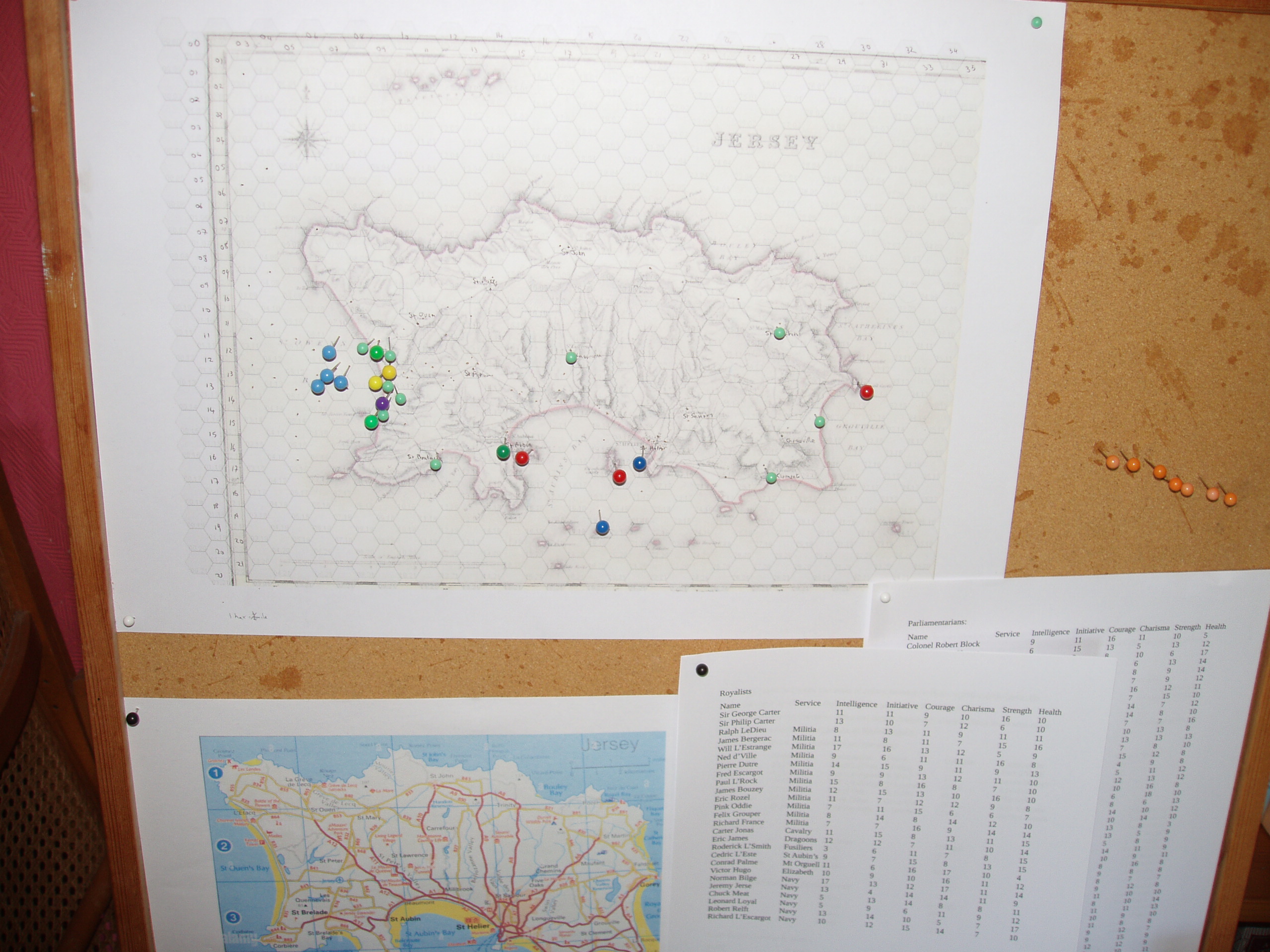
The campaign board was thus set up.


Here you can see the main campaign map at the top, printed on A3 paper with the nice hex grid superimposed. I did encounter a bit of a problem in struggling to read the numbers, but I managed, making a mental note to increase the contrast if I ever do this again. The commercial road map is at the bottom left, which also handily shows the beaches, and the orders of battle, unit identifications, and personalities of the commanders are in the two documents pinned to the bottom right.

The various pins in the main map are, of course, the defending forces' initial positions. Jersey had twelve parishes, as I recall, and each had a militia company to call on, so they are in green, except St Helier which has a double company. There is also a company of fusiliers, a troop of dragoons, and another of cavalry based there. The red pins indicate static garrison troops at St Aubin’s Tower, Elizabeth Castle, and Mount Orgueil Castle (east coast). I also decided to give the Royalists a small naval force based in the harbour at St Helier.

The Parliamentary fleet arrived from the northwest and as they came in sight of the island Colonel Block called a council of war aboard Lion, his flagship. After some poor dice rolling on behalf of Block and his senior officers, they decided to do the obvious and attempt to land at St Ouen’s Beach at the western edge of the island. However, the weather was not good and they had to sail up and down for a day or two for it to moderate to a nice if fresh, southerly wind.

In the meantime, couriers had been busy on the island, summoning the militias and other troops to rendezvous on St Ouen’s beach. This process was a little slow but ultimately successful, and much of the militia, plus Carter’s mounted troops and the fusiliers arrived at St Ouen’s Bay before Block’s troops were ready to land.


The picture shows the campaign map at this point, with the cluster of Royalist map pins on the shore at St Ouen’s. If you look closely you can see that the Royalist fleet, or most of it, is working its way out of St Helier. This was a bit tricky as the wind was southerly and there are a load of rocks not far out to sea, as you might observe.

I have to confess to a bit of cheating with time and ground scales. The map is about half a mile to a hex, I think, at least given the size of Jersey. After some initial um-ing and ah-ing I decided that foot would move two hexes per map turn and cavalry and couriers four. Naval units would move between one and four depending on the wind strength and direction, alongside tactical considerations – sailing ships can slow down by shortening sail.

I decided on four map moves per day, three in daylight and one at night where the movement rates were halved. I also included the weather. A roll for the wind direction and another for strength, and a roll for the weather conditions themselves. This rather delayed matters for Colonel Block, as the wind for the first couple of days was blowing from the west, which made making landfall at St Ouen’s a bit risky as the ships would be heading for a lee shore. When it shifted to from the north Block struck. I am still not sure about this, because halfway through the game (eight wargame moves equal one map move, by the way) the wind shifted to blow from the northwest, so the fleet was now in danger of being caught again. Mind you the Royalist fleet was also tangled up by the wind and its change in direction having to shift itself back towards St Helier to avoid being driven onto the rocks.

Anyway, the stage was set for a nice little amphibious wargame. To avoid some of the mistakes of the last time around, I put some thought into the naval bombardment. At the Council of War Block had already designated Unicorn and Elizabeth (the fifth rates) to lead the force into the bay and commence bombardment. I decided that the artillery rules would be as normal in my land rule. That is, over four base widths in range you have to roll a six to hit, and then resolve the combat. There is a logic to that which I will explain sometime, but not here.

I reasoned that the naval ships, having cannons in profusion compared to land forces, would count as a certain number of batteries, my reasoning being that more guns at longer range and a more unstable platform would more or less cancel out the range issues. So the merchantmen, if they chose to use them, would have one ‘battery’, one shot, that is, the sixth rates, when they appeared, two, the fifth rates three, and the fourth rate, four.

As for landing, once the ships were anchored in the bay, the company captains would be tested for initiative and those that passed would spend a move loading their men into rowing boats, which would then move at normal speed to land. One anything but a six they would be able to disembark, but would suffer two levels of terrain shaken until they rallied. On the other hand, the Royalist troops were further back than last time, just moving up from their camps.

I hope you want to know what happened next. Well, tune in next week for another exciting episode...


Saturday, 17 September 2022

The New Model Army

When does a revolt become a revolution? That is one of the questions raised by a book I have just finished:

Gentles, I., The New Model Army: Agent of Revolution, 2022, Yale, New Haven.

This is actually the second edition of Gentles’ 1992 book on the New Model Army, which took the story to 1653 and the end of the major fighting. In the preface, Gentles admits to having had to condense some parts of the original to add new material on the succeeding eight years, and also update the whole in the light of thirty years of extra research.

The result might disappoint the purely military wargamer but is of great interest to many more general historians and, indeed, wargamers, although Gentles himself bemoans the lack of military history writing and research about the civil wars. Still, his ideas on what made the New Model Army such a formidable fighting force are of interest. As he observes in the epilogue, what really matters to a fighting force it its morale, the spirit of the army. Here the early New Model Army was streets ahead of its opponents, whoever they were, at least until the mid-1650s.

It is rather interesting to read different books about different aspects of the English Civil Wars are find them pointing to the same period. James Scott Wheeler, in The Making of a Great Power, points to the legislation passed by the Long Parliament in early 1645 as definitive for the creation of the financial apparatus to fund the New Model Army and future wars. Gentles points to the same period as the key to turning the English Civil War into a revolution.

Prior to the creation of the New Model Army, and even to some extent afterward, there was a clash on the Parliamentary side between the war and the peace party. After a lot of parliamentary shenanigans, the war party won got their army and the commission they required for Sir Thomas Fairfax as commander. The key point in the commission was that it did not include a clause requiring the protection of the king’s majesty and person. Gentles argues that this meant that those who framed and forced through the commission meant to end the war by defeating the king’s party, whether it cost the king his life or not. That, he says, is the moment when the rebellion became a revolution.

The early campaigns are rather skated over. Naseby gets a few paragraphs and the south-western campaign a bit more but not much. This is interesting and possibly is where the cuts in the book occurred because I would have thought that the tradition and expectation of victory that Naseby, Langport, and the rest brought were important in convincing the army and its commanders that God was really on its side. Still, the later campaigns get more coverage, with Preston, Ireland, Dunbar, and Worcester being given sizeable chunks as well as maps.

There is a fair bit about politics and the army, of course. The interplay between the radicals, mostly junior officers with some senior support, and ordinary soldiers, particularly cavalry troopers is fascinating if verging on the bonkers. The Putney debates, the influence of the Levellers, Pride’s Purge, and all the usual suspects are present, including the trial and execution of the king. The problem was that no one really, except a few radicals, wanted to execute the king. Cromwell had a shrewd idea that chaos could be the result and it would be very difficult to secure a settlement without the king, but no one trusted him anymore. Charles seemed to think that would protect him. It rather ensured his son’s ultimate succession.

There is plenty of interest in the book. The expedition which landed up in capturing Jamaica gets a bit, emphasizing the organizational chaos and complacency that led to the debacle. If you start to think God is on your side, sometimes the concept of preparation gets rather lost. Unfortunately, while the government of Ireland and Scotland post-conquest get a fair bit of coverage, the Dunkirk expedition does not. There is, I suppose, only so much room in the book.

The fundamental problem for the New Model Army in the government in the 1650s was the cost of the armed forces. They were the guarantor of the regime and to Godly Cause, but were hideously expensive and, if unpaid, the army took free quarter which made it very unpopular in the country. In the end the Protectorate was bankrupt, as was the reconvened Rump Parliament in 1659. The general in Scotland, George Monk, who had reasons for not being a fan of the Rump, carefully bided his time until support for the army and the Junto of senior officers had ebbed away and then intervened decisively. Gentles is of the opinion that Monk had decided what his aim was earlier than many historians think, and certainly earlier than Monk himself admitted.

Monk’s political abilities enabled the Restoration without, as Richard Baxter observed, so much as a bloodied nose. The army acquiesced and was mostly disbanded, although it did get arrears of pay. The rank and file, it turned out, did not much care for the Good Old Cause, but they did want their pay. The radical officers had managed to alienate pretty well everyone, and the grandees of the Wallingford House Junto dithered indecisively until it was decisively too late.

Everyone, it seems, underestimated Monk. It goes to show that if you can manage that, you only have to be averagely competent and you take everyone by surprise, I suppose. If the grandees, particularly Lambert and Fleetwood had managed earlier, more decisive action, things might have turned out differently. Lambert headed a bigger force than Monk’s and tried to stop his advance. Morale, again, was the key. Lambert’s men deserted. As Gentles observes, this was not the New Model Army of the late 1640s or early 1650s, but a different, disliked, underpaid and under-resourced force. The army for the Caribbean under Venables was the scraping of it. No wonder it performed rather poorly. Perhaps the writing was on the wall then.

Saturday, 10 September 2022

Phew! Just Made It

Now I hope you are aware, as my regular reader, that I am not one to crow or show off, especially about my painting ability. However, over the last two years or so I have been trying to climb Mount Impossible, also known as reducing the pile of unpainted toy soldiers by a significant amount. This was sparked, in part, by the Estimable Mrs. P observing, recently, in her usual Delphic manner, ‘Unread books are useless, and unpainted soldiers are useless.’

Guilty on both counts. One might almost think that she knows her husband reasonably well, and knows where to strike for maximum effect. On the other hand, she has provoked a spate of reading, as recent posts will show, and some painting, which is the focus here.

Last year, my noble reader will recall, I managed to paint a total of 1024 little men. This reduced my lead pile to 845 toys, the difference the eagle-eyed will have spotted is accounted for by the 179 Muscovites which were added to the pile and painted in the same year (Shock! Horror!). That left me with about 1500 left to paint, of course.


The screenshot above shows the 1928 outstanding items at the beginning of my painting year (October 2021). Before anyone observes that there are more than 1500 or so items accounted for, I have added in the yearly purchases, this time of 288 ECW infantry from Lord Baccus, which appeared at Christmas, and the 28 ships for the Anglo-Dutch War which came in February. It is no wonder that reaching the bottom of the lead pile is a receding target. I have also added in the fifty (or so, they are a bit tricky to count) 25 mm plus figures I came across buried deep in a box. Such is the lot of the wargamer, I suppose. You hide these things away from your nearest and dearest, and yourself, and then, years later, they magically appear to torment you.

Still, I did set about my yearly target of 1000 figures with some modicum of enthusiasm and reported some reasonable progress by the mid-point of the painting year. I did get a bit stuck with the ADW ships, as was also noted at the time, and my claim is that without these I would have done even better. An excellent argument, I can claim, especially as it is impossibly to disprove.

Those of you who are waiting for the detailed result with bated breath (is there anyone) will be relieved to know that my spreadsheet skills have been kept up to date by creating the following.


What you can see above is the near exhaustion of my stocks of ECW troops. The Irish foot, who had been hanging around for a couple of years, was completed and took part in the Benburb game. The outstanding Scottish cavalry was also finished, with some of them being contributed generously to the Irish as well. As I noted I did manage the ADW ships, who have appeared (some of them, at least) in action, and also a few of the biggies which have been painted and/or repainted.

For the rest, I have been rounding out assorted ancient armies. The Marian Romans got skirmishers, cavalry, and bolt-shooters. The Greeks got cavalry and bolt-shooters. The Celts got skirmishers, tribal foot, some extra light cavalry, and some chariots (you can never, in my view, have enough chariots). I also finished off the imitation legionaries and unpronounceable Greek foot for the Pontic army. They did not particularly need them, but there you go; it is nice to have the option. The last lap has been to tackle the Parthians, which in fact were not touched by the doubling project of a few years ago, and therefore had been languishing with only twenty bases. They have now been augmented by 7 bases of cataphracts, 12 of skirmishers, and, so far, 12 of light horse, with another 6 bases undercoated and awaiting painting. Not that they are all based as yet, but I count painted as finished, or I would go mad.

So, I hear you cry: ‘What of the future?’ Good question, and I am glad you asked. The current total is that I have 990 figures left for the coming year. If I manage to outstanding 24 Parthians, that will drop to 966, so obviously I am going to have another push at the ancients. I shall probably start with the Dacians, as they are the current biggest unpainted pile.

You might wonder, incidentally, where the figure of 990 comes from. If you subtract 1024 from 1928, as in the total above, you get 904. Well, all I can say is that the wargame figure fairies have been active and have mysteriously added 72 Celtic tribal foot. I discovered them in the same bag as the Parthians, and I have no idea how they got there. This is, I suppose, another hazard of having a lead mountain: things get mixed up.

Now, of course, rumour has it that when a wargamer has finished their pile of unpainted lead, they die. Fear not, gentle reader, for I have undertaken further investigations of my storage boxes and have unearthed another 554 1:72nd scale medieval figures, from assorted manufacturers. I do have, somewhere (in another pile of storage boxes inevitably) some painted ones, nearly enough for a DBA army, I think. I suspect the project ground to a halt because of a bit of a lack of bowmen, but I cannot remember. Certainly, the Robin Hood figures seem to have had their archers thoroughly looted, so I presume they were painted. I must have a look sometime.

So there you are. I know 1000 or so 6 mm figures is not much by some people’s painting standards. I saw someone who had done 3000+ last year, and to a far better standard than I can dream of. But I do keep plugging away and, hopefully, as the lead pile diminishes I will start to feel less guilty about spending my hobby time playing games rather than painting.

Saturday, 3 September 2022

The Making of a World Power

I think it was Geoffrey Parker who observed that perhaps the most interesting thing about world history is not how the Europeans manage to nab 80% of the world (or so), but how they managed to grab the first 30%. The point is that at the end of the European medieval period, Europe was a largely ignored and ignorable lump of land at the far end of Asia. All the interesting stuff happened elsewhere.

That, of course, is a gross simplification, but there is a point. Parker, after all, is interested, when he made the comment, in the ‘military revolution’ of the early modern era, which, he claims, enabled the first thirty per cent take over of the world. Perhaps. The military revolution is a bit of a disputed idea and happened at different rates in different places.

By focussing down onto one country we might be able to see what was going on, at least in a more localised sense. This is the intention of

Wheeler, J. S. The Making of a World Power: War and the Military Revolution in Seventeenth Century England (Stroud, Sutton, 1999).

This is another book I pulled off my shelf recently, having read it ages ago and not really recalling what it had to say. An interesting read to be sure, but not really one about the military revolution. It is more about the financial revolution which, Wheeler argues, went alongside and was necessary to the military revolution occurring.

England is an interesting case. During the reign of Elizabeth England and her views and resources mattered. Her navy dominated and her money propped up the Protestant cause in north-west Europe. Elizabeth’s war aims were to ensure that the Channel ports were in friendly hands and the secure the Protestant cause. In spite of the costs of war she managed that, but the government was plunged into debt. Late Sixteenth Century was no place for the financially feeble, as even the Spanish found out.

After the 1604 peace and the reconquest of Ireland, James I cut military expenditure massively. The navy mouldered (not quite as much a Wheeler argues, I think, but overall it was much reduced in strength) and the army vanished. Even the events of the opening of the Thirty Years War did not bring forth much reaction from the English court, basically because intervention was unaffordable.

Charles I’s wars against France and Spain were likewise too expensive to be bourn and were national humiliations to boot. Charles opted for peace and non-intervention, picking up money from foreign powers where he could.

In the mid-1630s came the ship money fleet. It was really a no-brainer that England needed a fleet, but the question of how it was to be paid for was vexing. Charles extended the ship money, a historical levy on coastal counties for their protection, to the whole country and the law courts found that he could. It bought in a fair bit of cash and, in fact, set up the first peacetime Royal Navy in England’s history. Prior to then the navy had been a bit ad hoc, shall we say.

All might have been well if Charles could have avoided internal conflict. He created a war with the Scots which he could not afford and his financial creativity annoyed a lot of English and Parliament when he was forced to recall it. The English had the idea that the king should live off his own income in peace time. The royal finances in fact showed this was impossible.

The point here is that warfare had become really expensive and that inflation had reduced the value of Parliamentary subsidies anyway. Elizabeth had sold off crown lands to balance the books, but that was a diminishing recourse. As England plunged into civil war both sides were left with the question of how they paid for the conflict.

Initially the measures were ad hoc – loans, gifts and seizures lasted for a couple of year. By the end of 1644 however, the Parliamentary side was at financial breaking point, as well as getting war weary. Something had to be done.

The something was the reformation of both the army and the government’s finances. This, Wheeler argues, laid the basis for the rise of England to world power status by the end of the century. Loans were taken out secured by the income from the three main sources of government income: customs, excise and the assessment. The customs supported the navy while the excise (a sales tax) and the assessment (which became the land tax) went to the army. Or at least, loads based on the anticipated revenue did.

After teething troubles the system worked. The Protectorate managed largely to pay for its military forces, only causing a financial crisis at the end (after 1655) by radically cutting taxes, which contributed to the fall of the regime. The post-Restoration government kept the assessment (which was based on Charles I’s ship money assessment) and, despite protestations to the contrary, the standing navy and army. The country was more heavily taxed than Charles I could have dreamt of especially in peace time. The government got away with it because Parliament had largely assumed responsibility for the nation’s finances.

Wheeler’s point is that the military revolution brought into the country by Elizabethan and Caroline warfare, the experience of English, Irish and Scottish soldiers in Europe and the outbreak of civil war entailed a financial revolution which was overseen by the Long Parliament. England rose to be a great power during the middle and latter part of the Seventeenth Century on the strength of it, and it was consolidated, rather than started, by the foundation of the Bank of England in 1694.

The fact that there was remarkably little resistance to the taxes indicates that, on the whole the nation acquiesced to their collection. Additionally, the excise, introduced in 1643, was a tax on all English people, not just on the wealthy. The government started reaching into all citizen’s lives at that point.