Saturday, 7 November 2020

Small Boat Sailing

 ‘So, this is Spinoza’s will?’

‘Yes, ma’am.’

‘And what does it say?’

‘For the state, ma’am, he recommends establishing Dunkirk and Ostend as privateer bases.’

‘Already done.’

‘Also, he suggests not assaulting the rebel’s fortresses any more.’

‘Really? What are we to do instead. Madrid will not be happy with the answer ‘nothing’, you know.’

‘No, ma’am. He does not suggest nothing. We should use the ships from the armada, and the troops, to outflank the rebels from the sea, cut off their maritime trade and seize the undefended islands. If we can fortify the towns on the islands, then they will have to come to us while we throttle their trade.’

‘Cunning man that Ambrose.’

‘Yes, ma’am.’


*


As any discerning wargamer of the Seventeenth Century will know, the Hispano-Dutch wars, once it resumed in 1621, got bogged down in sieges, and no-one really got anywhere. The real action was at sea, both in the Narrow Seas (much of the Dutch trade was, in fact, with the Baltic) and also world-wide. With the East- and West-Indian Companies grabbing trade and trading posts across the Americas and the Indies.

According to Hugh Peter’s account in his pamphlet (‘Digitus Dei. Or Good News from Holland’ p 157-172 in Randall, D., English Military News Pamphlets 1513-1637 (Tempe, Arizona: ACMRS, 2011)), Spinoza left exactly that above suggestion in his will to ‘the Infanta’, Archduchess Isabella, co-ruler, ruler and governor of the Spanish Netherlands until 1633. Again, according to Peter this waterborne assault took place in September 1631 by over eighty Spanish ships. The Prince of Orange, Frederick Henry of Nassau had already retreated from his invasion of Flanders (possibly aimed at Dunkirk, but that might seem a little ambitious) and was forced to dispose of his army against the sea threat, and also launch a naval effort against the incoming fleet.

It all went wrong for the Spanish, many of the sips ran aground in a mist and the whole seems to have been a logistical nightmare. Hugh Peter, of course, acknowledges that the defeat was from God.

Never being one to pass up an excuse like that for a wargame, I pondered my naval assets. Peter actually provides a fairly useful list of troops, sailors and ships (as well as other equipment) which came to 3274 soldiers of all ranks captured, 855 sailors (out of 6000 who left Antwerp). Peter also lists 62 vessels captured although not all of them were warships; the ammunition ships are listed as carrying powder, beer and ‘Deals’, which might be planks or wine.

The geography described by Peter is confusing, at least, it confused the socks off me and, of course, modern maps are fairly useless as a great deal of draining has occurred. The landscape (seascape?) even seems to have changed between 1630 and 1660 as the engineers got to work. So I gave up the idea of a precise reproduction of the events, and went for something ‘inspired by’ them.

Further investigation of my small craft indicated two slight snags in the plan. Firstly, I did not have very many and secondly, the ones I did have were poorly painted even by my low standards. Two of the brigs, for example, had no paint at all applied to one side. Having sworn off Hallmark Miniatures, I was at a bit of a loss until I recalled that Tumbling Dice have assorted ranges in 1:2400, and an order was placed and swiftly despatched. I set to to paint somewhere around fifty craft – being a solo player means you have to have sufficient for both sides. However, it turns out that simple paint jobs on ships are nearly as easy as buildings, and the whole project was only delayed by a fortnight or two.

I did have to invent some terrain. The problem is that at 1:2400 scale, a six-foot-tall human is about 0.83 mm tall. Thus the edge of a piece of felt could be a six to eight-foot cliff. Further, no-one seems to do any buildings in 1:2400 scale, a problem which I have encountered before but not solved. So some imagination was required.

After a few moves, the table looked like this.


The Spanish are sailing from the near edge of the table, in a lump, headed by a ‘hulk’ flagship. Their aim is to capture the two villages to the left, the little brown felt squares. This will interdict maritime traffic from Bergen, in the distance, from which you can see the Dutch starting to emerge. The pale bits are sand-banks or dunes. The dark blue bit is the ‘danger area’ where unwary ships entering are likely to run aground. There is a channel or two through the dunes at the end of the island, through which some optimistic Spanish ships are aiming to pass.

You can also see that there is more clutter on the table than I usually like. These consist of a wind direction marker, a weather tracker (I had, after all, to give a chance for some mist) and a turn tracker, to keep an eye on the tides. The weather rules were nicked, incidentally, from Charles Wesencraft’s ‘With Musket and Pike’.

The main clash of the fleets was in the restricted waters to the starboard of the island. The table edge, of course, was the other shore, and the Dutch landed up being rather pinned against it.


The Dutch, under their admiral the Prince of Orange in the leading galleass split into two to shoot up the Spanish who sailed obligingly between them. However, most of the Dutch ships lost out in the artillery duel and the port squadron (nearest the camera) was forced to sheer off and ran aground, at least in part. While receiving some damage (you can make out the markers if you look) the Spanish sailed fairly serenely on. In the top left of the photograph, you can see the flying squadron has taken one of the villages with consummate ease, the relieving Dutch squadron being hampered by the wind.

It did not really get much better for the Dutch. Attempts to refloat the Prince’s ship led to it sinking (a failed refloat gives a possibility of damaging the ship), the Prince himself being unharmed by captured after struggling ashore. Most (even more?) embarrassingly, the starboard squadron of the Prince’s force largely ran aground trying to get through the channel in the dunes. The Spanish armada sailed on.


The picture shows the situation when I gave up. The Dutch relieving squadron is about to reach the second village; the Spanish main force will not, however, be far behind. To the right, you can see the remainder of the Prince’s squadron aground or struggling to catch up given their damage levels. Even if they do recover, they are going to struggle to get past their own ships as the tide is going out.

It is a good thing when a wargame leads to another. In this case, there are two – the Spanish assault on the second village, now defended by Dutch soldiers and sailors, and the Dutch assault on the first village, now defended by Spanish soldiers and sailors.


*


‘Prince Frederick Henry, ma’am.’

‘Ah, Freddy. Nice of you to drop by. Do come in. Have you dried out?’

‘I have been well treated.’

‘Excellent. Well, you know, we must set you a ransom. Your fellow traitors are quite keen to have you home, you know.’

‘A ransom?’

‘Yes. What shall we say? The whole of Zealand and Holland?’

Saturday, 31 October 2020

The Medieval Military Revolution

One of the things I have banged on about on this blog over the years is the military revolution in early modern Europe. As my loyal reader will recall, this was first suggested in the 1950s by Michael Roberts, and extended in the 1980s by Geoffrey Parker and has generally stimulated a fair bit of historiography around the ideas of state formation, taxation and the increase in size in armed forces, particularly (although not exclusively) armies and fortifications.

The consequences have been perhaps, a great deal more heat than light, at least as far as the humble wargamer might go. How much the wargamer is interested in the details of state formation and military finance depends on the sort of person, at least so far as history goes, that one is. Most wargamers are not that interested in the financing of the Spanish army in the Low Countries in the 1580s, it seems to me. They are interested in the battle the army fought.

As I mentioned, however, one book leads to another. My readings on ‘waste’ in the Domesday Book have led me to:

Ayton, A., Price, J. L., eds. The Medieval Military Revolution: State, Society and Military Change in Medieval and Early Modern Europe (London: I. B. Taurus, 1998).

This is, of course, a book of essays on various aspects of the military in the period from around 1066 to the Seventeenth Century. I say around 1066 because the first essay is about whether the historian can trace the movements of William the Conqueror's army after Hastings by references to waste in the Domesday Book for the relevant counties. As I intend to return to this topic at a later date, I will leave the interested reader waiting for the answer to that one.

Having bought the thing (the university library is inaccessible, at present) I did what most red-blooded historical wargamers would do with a book, and read the essay I was interested in, and then the rest of them. And jolly interesting most of them were too.

To take the least wargaming relevant ones first, there are two essays on the just war in early modern Europe, one on the views of Erasmus of Rotterdam and the other on a Paris theologian Josse Clichtove. I had not heard of him either. Erasmus was a virtual pacifist, Clichtove was not. But the authors are at pains to observe that neither came to their views in a vacuum – the church had views on war and its conduct from the tenth century at the latest.

Other items of interest (the Estimable Mrs P observed when I was talking about the latest History Today issue ‘You say that all of the articles are interesting.’ Guilty as charged, I am afraid) include town defences after the Norman conquest, the gifting of land to the Templars (including two and a half carucates in the village in which I dwell – I shall have to look into that now as well) disputes about heraldry and what it tells us about the motivations to fight in the fourteenth century, the experience of Sir William Pelham, the Elizabethan engineer partially responsible for the defences of Berwick upon Tweed and the Dutch Republic and warfare.

Again, I shall come back to some of these topics, I suspect. But the overall question is tackled in the introduction by the editors: was there a medieval military revolution? As with any good undergraduate essay on the topic, the answer lies along the lines of attacking the question, rather than answering it.

There is no doubt that warfare changed between, say 1000 AD and 1500 AD. How much it changed is a bit of a moot point, of course. Various revolutions in military affairs have been found, including the rise of cavalry, the fall of cavalry and the resurgence of infantry. Further, there is the development of the castle and other fortifications and, of course, siege engines and techniques. Slightly surprisingly to me the authors do not cite Clifford Roger’s article on infantry revolutions in the Hundred Years War which dates from 1993, but I suppose there is only so much you can put in.

The most relevant of the factors which are said to introduce the early modern military revolution is the introduction of gunpowder. This, however, dates for the mid-fourteenth century, not the sixteenth. The cannon was used effectively by the French to blast the English out of Normandy and Gascony by the 1450s as the Ottomans were taking Constantinople. Harfleur, which Henry V had to starve out over months in spite of having cannon, lasted a couple of weeks when the French returned in the 1440s. Warfare, at least in terms of positional and territorial control, had changed.

Perhaps the most interesting part of a medieval revolution is the balance between defence and offence in siege warfare. The balance did shift between 1450 and 1530 and so that was a time of more field battles as important positions needed to be besieged (with some hope of rapid success) and relieved, thus forcing actions upon the commanders. After 1530 the pace of campaigning slowed again as the new fortifications came into effect, and battles became rarer.

The upshot is that the editors do not answer their own question (of course) but do observe that there were radical changes in warfare in the medieval period. That extension, of course, calls into question the whole idea of there being a revolution in military affairs at all. If we extend the period of change from, say, the early fourteenth century to the end of the eighteenth century, we hardly have a ‘revolution’ at all, more an evolution. The problem seems to be both the definition of a military revolution and the time frame which we impose on our history. There are continuities and disjunctions all along the line, and the changes which really did take place are part, perhaps of both. We have to have our cake and eat it, it seems to me here, no matter how indigestible it might seem.

Saturday, 24 October 2020

Domesday Now

Is it just me, or should there be an exclamation mark after the second word of the title? Perhaps I am just one of the Apocalypse Now! Generation, although I cannot be bothered to look up whether that had the punctuation. On the other hand, I also recall an obscure TV comedy called Whoops! Apocalypse! Which did have punctuation, although I don’t recall exactly where. To be honest, all I do recall was the SAS storming a gents lavatory on a cross channel ferry and the US President, looking very like Ronald Regan, crash landing the Space Shuttle on Moscow and sparking the aforesaid nuclear holocaust.

I digress, however. This book is:

Roffe, D., Keats-Rohan, K. S. B., eds. Domesday Now (Woodbridge: Boydell, 2018).

As the edited state suggests, it is a book of essays, subtitled ‘New Approaches to the Inquest and the Book’. The contents are papers from a 2011 conference on the subject, so the claim of the word ‘Now’ is a bit subjective. However, someone clearly thought it was worth publishing as a paperback in 2018, and I suspect that as work on Domesday Book and its environs go it is as up to date as any.

The assiduous reader of the blog will recognise the name of the first editor, David Roffe. Aside from the introduction, he contributes three out of the twelve essays, a pretty good strike rate. In the first, he provides an overview of how studies of the Domesday Book have progressed over the years. In the second we have a detailed discussion of some of the ‘scribal devices’ used in the Domesday manuscript. The ‘diplomatic’, which appears to be the stuff actually comprising an entry, gives us certain clues as to what the scribe was doing when writing. For example, a marginal ‘m’ indicates that the place in the entry was a manor. Different forms of the initial letter of entries suggest different dependencies: dependent lands are marked with a rustic letter (often a capital I) while an independently held land holding gets a square I. This is difficult to reproduce in anything but a facsimile of the manuscript itself (which is, incidentally, falling apart).

Roffe’s third essay is about the role of the records of the Domesday inquest post the inquest and presumed initial use to which the returns from the counties were put. The book itself became something much used by medieval exchequer clerks and such like. It is, of course, Roffe’s argument that the book only reached its present form after the 1088 rebellion against William Rufus, when the government had to figure out which lands to remove from the defeated rebels. Creating the Domesday Book as we know it, with lands ordered within a county by landholder, could well have facilitated this task.

Roffe’s model of the creation of the returns for Domesday Book is one of a fairly gentle, normal process of vill, hundred and county juries stating what they knew of who held what from whom in 1066 (on the day when King Edward was alive and dead) and now. This was a fairly standard Anglo-Saxon process, albeit on a grand scale. Roffe argues that to pay geld was to be free, and so no-one had much interest in lying about their tax returns and the whole thing was a fairly civilised process.

Sally Harvey, in her essay, disagrees with Roffe, pointing out that while the inquests might have been fairly standard, violent coercion was not far behind. The inquests were conducted under oath, and oath-breakers were of course eternally damned as well as being liable to earthly sanctions. For example, there were ordeals to but undertaken if no resolution to a dispute could be found – ordeal by water or by hot iron. The priest adjudicated as to the innocence of guild of the person undertaking the ordeal was innocent or guilty. Harvey suggests that the threat of the ordeal in the Domesday inquests was shocking, as any perjury committed was not, under Anglo-Saxon law, criminal, so did not require it. The Normans also introduced trial by combat, which seems to be referred to around six times in the Domesday corpus. Out of 29000 returns that may not be many, but the point is that the threat of ordeal, by whatever means, was sufficient implied violence to coerce compliance with the Domesday questions.

Aside from this ongoing argument, and disagreements as to whether the Book was an expected outcome of the inquest, there are other interesting essays. There is a fair bit on the production of an electronic, searchable, version of the Domesday Book. Naturally, these can be a bit out of date, but they do indicate that the creation of online resources is no easy matter. Another essay on using geographical Information Systems for Domesday studies is interesting, but again shows the difficulties of converting an Eleventh Century text to Twenty-First Century technology.

Perhaps the most interesting comment to me is the suggestion (by Ian Taylor ‘Little Domesday Reconsidered’) that as the Anglo-Saxon Chronicle records that in 1085, to oppose the feared Danish invasion, William had ‘the land near the sea laid waste’, this might be expected to appear in the East Anglian records in LDB. But the relevant counties do not record any significant ‘waste’ or decline in values at the time of the inquest. He notes that only in Yorkshire is there significant waste, and that the Crowland chronicler states that the 1085 wasting was in Northumbria. This is not Taylor’s point of interest, but it is mine, and it might suggest that the large quantities of waste manors in 1086 was not due to the harrying of the North but to a later scorched earth policy aimed against renewed Danish invasion and those who might sympathise with them.

As is often the case, one book leads to another, or in this case, two others, as the literature on waste points to two further essays by J. N. N. Palmer in two different books. Ho hum. I have some more reading to do.

Saturday, 17 October 2020

Rearguard Action

‘Bring them on!’


‘They are coming Jez, don’t worry.’


‘We will see them off!’


‘Well, we need to delay them, Jez. And out situation is not all that clever really.’


‘The Lord himself fights on our side!’


‘Um. Well, that would be helpful. There are a couple of problems, though.’


‘Problems? What sort of problems could there be? Our cause is righteous!’


‘Well, the reckon their cause is righteous as well.’


‘They are wrong and we are right!’


‘Of course, of course. Would you mind putting that flail down for a minute, please? They are not here yet.’


‘I will smite all unbelievers wherever I might find them.’


‘Yes, of course. Try not to smite anyone just now Jez; we need everyone here.’


‘What is the other problem?’


‘Well, we are not in a great position here. If they get across the ford we could be in trouble.’


‘We are in this field and will smite the unbelievers from behind this hedge!’


‘Yes. But they might smite our troops over there in the open.’


*


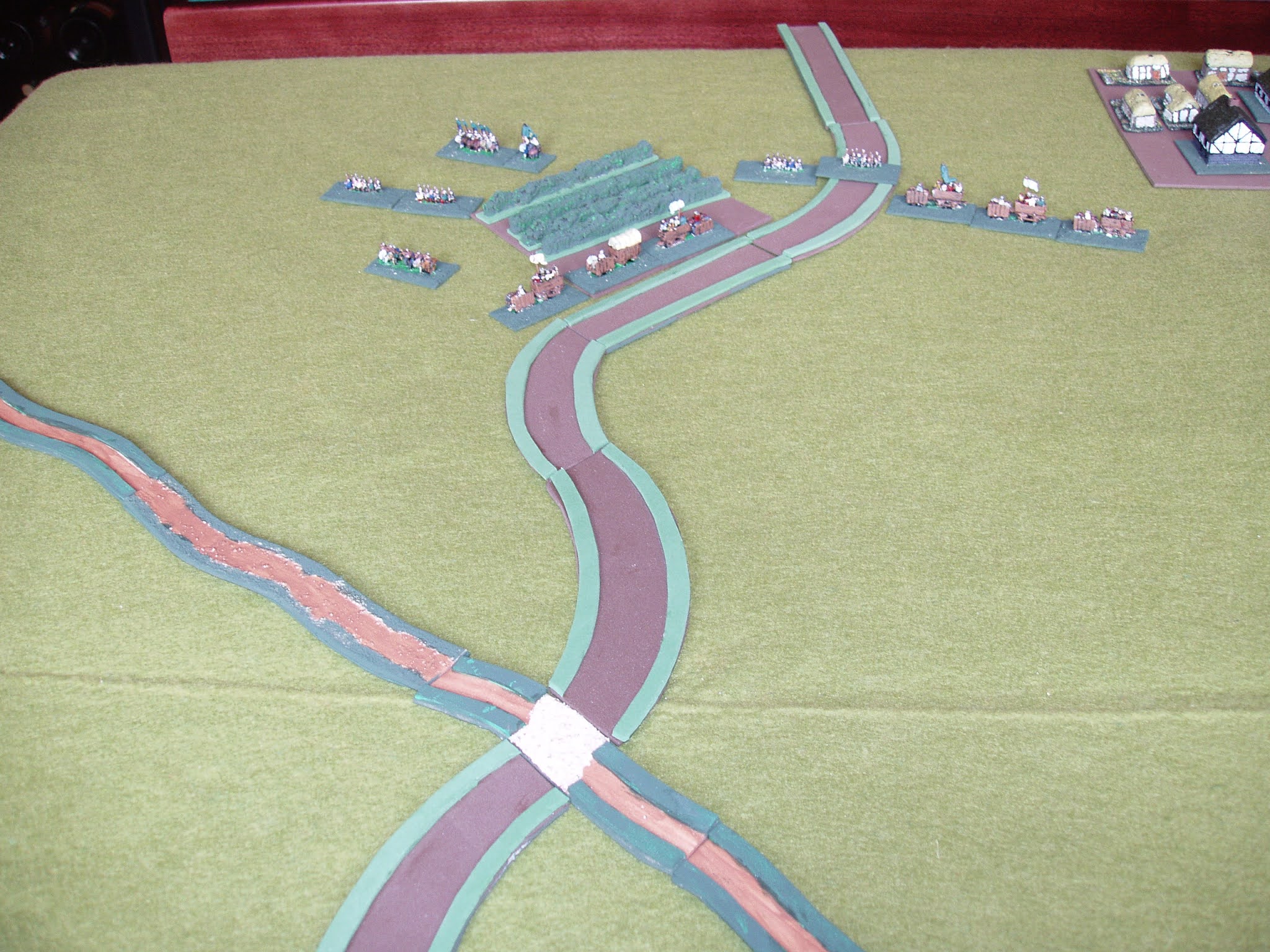
Well, the Hussites are retreating from the ‘Small Town in Bohemia’ and need to delay their pursuers, the German Crusading army somewhat in order for the army to reach safety. Inevitable the warlike Jez and wagon crew have been chosen to be part of the rearguard. The terrain was not that favourable to the Hussites.


The picture shows the Hussite initial positions. The Germans will advance from the road nearest the camera across that bright blob which is a ford (I must have forgotten to stain it when repainting my stream sections). The stream runs all the way across the table. The Hussites have no suitable hill to station their war wagon on, so have taken to the edge of the fields and are strung out between the foot of a hill and the road. The wagon with the tilt, incidentally, is technically a Polish war wagon, here masquerading as an artillery wagon. I was most worried about the Germans outflanking the right of the Hussite position and so placed the mounted crossbowmen, half the bill men and the Bohemian knights to cover that flank.


After a few moves the Germans had arrived and were under bombardment as they crossed the ford.


The knights are moving right, not left as I had feared. The Hussite artillery and skirmishers are not proving at all effective. The figures are all Irregular and the village buildings are from various manufacturers – Baccus, Leven and Irregular, I think.

The game developed with a furious German mounted attack on the Hussite left, while the infantry attempted to go around the Hussite right. After some initial hesitation, the German knights charged home and destroyed two out of three of the war wagons (the Achilles heel of the war wagons is that they cannot recoil by are destroyed instead).


At this point, the Hussites were well and truly rocking with some bad dice rolls as well, and I was thinking that the game was over for Jez et al.  


The drone’s eye view shows the situation declining for the Hussites. A follow-up charge has destroyed the last of their left flank wagons, while the successful German knights have rallied from their charge. Bohemian morale has slumped to ‘waver’ and it seems that the Crusaders could be well on top. However, at the top of the picture, the Hussite knights are moving to shore up their left and the German centre has stilled in the fire of the war wagons, so all is not quite lost. I did nearly throw in the towel as Hussite commander at this point, but a rearguard is a rearguard at the end of the day and fights on.


A few moves later and things have stabilised a bit on the Hussite left. The Bohemian nobles have charged some of the rallying knights in flank and they are now fleeing. The Hussite knights sensibly did not attempt to rally from their charge in the open but hid in the village while they sorted themselves out. The German knights have seen off one of the central Hussite war flail bases but the other is retreating into the safety of the fields. On the other flank, the flail men are giving the German spears a hard time; with the German general in combat, it was impossible to coordinate activity on this side. The central war wagons have also been disrupting the German centre.

The end of the battle came when the Hussite war flail men on their right beat the German spears handsomely and caused them to rout. German morale then slumped to ‘waver’ (the Hussites, surprisingly had recovered somewhat).


The German infantry has withdrawn towards the ford or, for the leftmost spearmen, towards the stream, while the knights have simply fallen back a move facing the enemy. The Bohemian knights are still lurking in the village rallying while the German general and his attendant knights are in the far distance, also rallying.


At this point I decided that the game was more or less a draw. The remaining German knights were unlikely to make much impression on the war wagons, while the Hussites are necessarily on the defensive. A draw is, of course, a strategic win for the Hussites.


*


‘Come back and fight you cowards!’


‘Um, Jez, it is all right. They are retreating.’


‘Cowards!’


‘Just be happy that they are going. Then I can get this bramble out of my arm.’


‘We should be smiting the unbelievers!’


‘We did, Jez, we did. That is why they are retreating, you know.’


‘We have not smitten them hard enough!’


‘I think we have done enough for today, Jez. Let’s leave some smiting for tomorrow, eh?’


‘The Lord curses those who sleep and blesses those who do not slumber in his work!’


‘Well, we’ve not slumbered, Jez. I’ve been awake for two days.’


‘We shall not all sleep, but we shall all be changed.’


‘You’re telling me. When their crossbows started I nearly needed clean hose.’


Saturday, 10 October 2020

English Military News Pamphlets

Every once in a while you come across a book which just gives you ideas. I have been reading one such which pumps into my mental economy (something that is usually in recession, of course) a supply of suggestions that would give the Federal Reserves Quantitative Easing program a run for its money.

Before getting carried away with purple prose, the book is:

Randall, D., English Military News Pamphlets 1513-1637 (Tempe, Arizona: ACMRS, 2011).

Inevitably, this is an expensive academic book, brought by Mr Cheapskate here at a much-reduced price and based on the author’s 2005 PhD thesis. The fairly extensive introduction attempts to place the reproduced pamphlets in their context. Essentially, the earliest one in the book is the first one which is still extant, and is about the Battle of Flodden (1513, as any wargamer will know, of course) which mostly consists of a list of the nobility and gentry slain and another list of Englishmen knighted on the field.

The last entry is from 1637 and the Pequod ‘war’ which seems to have been more a massacre carried out by colonists Mohegans and Narragansetts. As Randall says in his introduction, this starts off as a military news pamphlet but then segues into a real estate brochure extolling the virtues of New England especially now the pesky natives have been exterminated.

After 1637, of course, the government imposed censorship on the press, because much of it was critical of the crown’s policies, both domestic and foreign. The book trade was already constrained by the monopoly of the Company of Stationers safeguarding privilege and profit, and the chaplains of the Archbishop of Canterbury and the Bishop of London watching for heresy, nonconformity and sedition. As any student of the 1630s will know, notoriously Burton, Bastwick and Prynne had their books burned, they were stood in the pillory, had their ears severed and Prynne branded with S.L. (for seditious libeller) in 1637, and they were all jailed.

The book trade was also subject to the observation of the Privy Council, Star Chamber and Court of High Commission. Many of the pamphlets start with a notice that they have been approved for publication: ‘Seen and allowed’ for example. After the start of newspapers in the early 1620s military news pamphlets became less frequent, but they still continued until state control was tightened in 1637 (Cressy, D., England on Edge: Crisis and Revolution 1640-1642 (Oxford: Oxford University Press, 2007, p 282-3). The problem was, of course, that any pamphlet or newsbook reporting on the state of the Protestant cause in Europe in the late 1630s was quite likely to be at least implicitly critical of the government’s foreign and religious policies.

Despite all this six or seven hundred items a year were published in the 1630s, and the collection has one of them by Hugh Peters on the Spanish invasion of Zealand in 1631. I had not heard of this, as I dare say most people will not have done. A check on my sources on the later Dutch Revolt (or Hispano – Dutch War by that time, I suppose) sees a sentence in Geyl and nothing much in Israel, both focussing more on Frederick Henry’s problems with the States rather than the military non-activity.


More about Hugh Peter’s Digitus Dei on another occasion, perhaps, as it has given me an idea for a wargame or two. There are reports in the book of the 1544 invasion of Scotland, the 1565 siege of Malta, news from Vienna in 1566, assorted news items from the French Wars of Religion, and the Spoyle of Antwerp from 1576. From the Seventeenth Century we have a letter from Ireland (1602) reporting on Kinsale, a report from a mercenary involved in the Swedish – Polish war from 1610, and the siege diary of Bergen-op-Zoom from 1622, alongside Peter’s tract and the one from New England.


All in all, it is a nice haul. Reading the tracts can be a bit difficult as the author and editor has preserved the original spellings, with footnotes indicating obscure words or old meanings. Once you get the hang of the writing and spelling, however, things are reasonably straightforward. It is a bit like my experience of seeing Shakespeare plays in live theatre; it takes me about half an hour to tune my ears into the rhythm and quirks of the language. I am told that the experience is similar for people using the Book of Common Prayer or the King James Version of the Bible.


Aside from the Hugh Peter text (which was very interesting, but I need to do more mulling over of it) the works are very interesting. They give a fresh, usually eye-witness account of the events of the time, even if they are rather underplayed in today’s historiography. I suppose then, as now, journalism is the first stab at history. You cannot know the importance of the events you have just witnessed until after you have reported them, if at all. For example, Peter compares the Spanish failure in 1631 with the failure of the Armada in 1588. Most people have heard of the former, but not many of the latter. History is a bit like that – what seems important at the time is a lot less important when a longer view is taken.


Randall notes that the rhetoric of the pamphlets changes depending on the subject. The reports from the European theatres are in general anti-Catholic, and anti-Spanish. Gascoigne’s pamphlet from the Spoil of Antwerp was part of the black legend associated with the Spanish in the later Sixteenth and Seventeenth Centuries, for example. On the other hand, Malta and Vienna were defended by Roman Catholics which is brushed over and any Christian fighting the Turk is obviously a good guy. On the other hand, Anthony Nixon’s report from the Swedo-Polish wars does not really focus on the differing religions of the sides (Lutheran, Catholic and Orthodox), but on the treatment and dangers faced by the common soldiers. As such it is perhaps more interesting than many; Randall notes that we have few reports of how the common soldier felt, lived and starved.


An interesting collection. Now, I need to consider how to invade Zealand.


Saturday, 3 October 2020

The Ambassador’s Tale

‘Excuse me sire.’


‘Yes?’


‘What is under your jacket, sire?’


‘Oh, it's just a, um, a bottle of olive oil, man. You know, for the cook.’


‘May I see, sire?’


‘Of course not man! I am the king! I order you not to look.’


‘I am sorry, sire, but the Queen issued strict instructions to inspect your person and baggage before allowing you on board.’


‘Oh. Well. I don’t have to come on board, you know.’


‘I am afraid, sire, that according to our instructions, you are not permitted not to come on board. Now, sire, this bottle of ‘olive oil’?’


*


Poor Ferdinand is starting to sound like a hen-pecked husband, but he does have a job to do and Isabella is determined to make him do it. As you might recall from last week, his mission is to intercept an ambassador from the Barbary States to prevent him from negotiating an alliance with the Grenadines.


Having just revived my Renaissance galley fleet it was nice to get them onto the table with a purpose in mind. The Spanish had a flagship (Ferdinand) and eleven heavy (ordinary) galleys, while the Barbary Coast fleet consisted of eight galliots, three medium galleys and a Lanterna for their flagship. There was also a merchant galley with the all-important ambassador aboard.


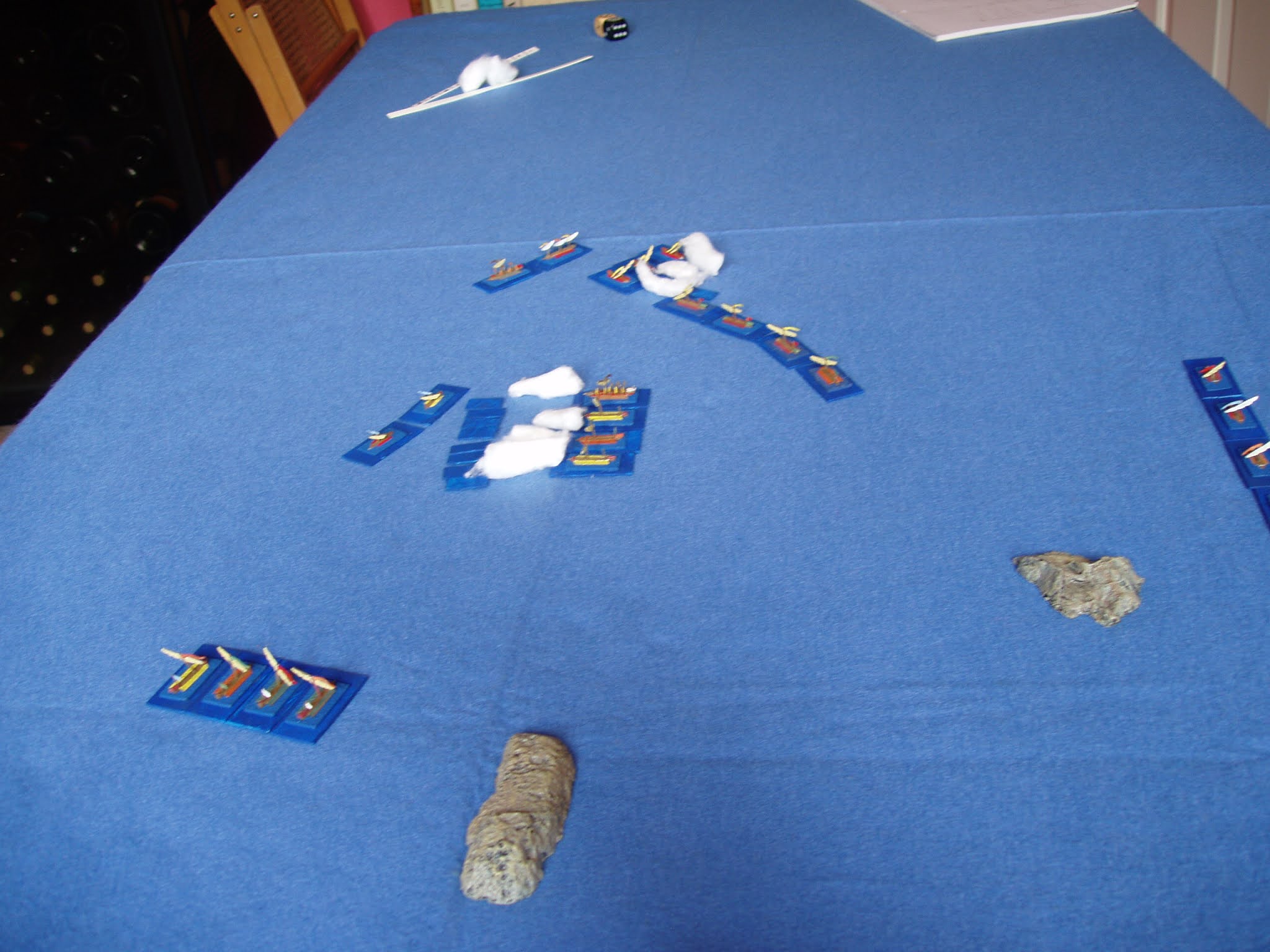
The pictures of the starting fleets did not come out too well and were a bit boring. The ambassador had to travel diagonally across the table (down the long bit) from ‘out to sea’ to the safety of Malaga harbour. The Barbary Coast fleet was to escort him there.


The picture shows the game a few moves in. Malaga harbour is in the near left-hand corner of the picture. The Spanish are in three squadrons; the left-hand squadron is going to block the route to Malaga, while the central and right (the centre one led by a very sober King Ferdinand) will assault the escorts to try to capture the ambassador. The man himself is in the centre-left column of the Barbary Coast fleet, the second ship back being the merchant vessel (it has three masts, incidentally). Recognising that the Barbary galliots are a bit light for a face to face fight, my plan was to outflank the Spanish to left and right and try to hit their rear when engaged with the heavier ships.


The ships are all Hallmark 1:2400 galleys, bought years ago when they were still in Leeds. The rocks are from Leven Miniatures.


A few moves down the line and it is going a little pear-shaped for the Barbary Coast. The Spanish blocking squadron is in place (to the left) while their own left-wing is a long way from the action. The right-wing galliots have attempted to block Ferdinand’s central squadron, which deployed into line and sank two of their protagonists. In the background, the Barbary Coast galley squadron has been forced to deploy to stop the Spanish right and is now trading shots with them. In the background, the Barbary Coast flagship and the merchantman are taking evasive action.


It did not get a huge amount better for the Barbary Coast fleet. The Spanish right pulverised their galley squadron (albeit losing one galley themselves). Ferdinand’s squadron attacked the lanterna flagship, causing a great deal of damage while the rest of his command was just managing to slip past the wrecks in pursuit of the ambassador himself.


A turn or two later and it is all over. The Lanterna has been sunk and the Barbary Coast fleet is starting to flee. The rear of Ferdinand’s squadron is now in artillery range of the merchantman which will surrender. It will then be escorted to Cadiz and the ambassador entertained by Ferdinand and Isabella.


The rules I used were ‘scratch’ ones, giving each sort of galley (galliot, medium galley, heavy galley and flagship or Lanterna) a number of hits they could take (from two to five) and a strike and defence value. Galliots can move faster but are worse at defence and shooting. Galleys can, of course, only shoot forwards. Boarding, if it had been necessary, would have been on the same basis. I might get around to writing them down sometime.


As it happened, boarding was not necessary. The Spanish had a large number of fluke good dice rolls to cause major damage to the Barbary Coast fleet. The idea was that one or two hits could be inflicted a turn, but actually the number of 6-1 results from the dice the Spanish rolled meant that they sank several ships at once. Mind you, the Spanish casualty was also a 6-1 roll.


I did wonder about the balance of forces and the scenario here. I mean, the galliots were hardly going to stand up to the might of the Aragonese navy, but I did think they might manage to slip the ambassador onto dry land. Historically, of course, the Aragonese navy managed, pretty well, to seal the coast from reinforcements from North Africa and that pretty well sealed the fate of Granada.


*

‘Ah, Ferdie, my dry and wet admiral. You achieved your objective, I understand.’


‘The ambassador is downstairs, my dear, awaiting your pleasure.’


‘Oh Ferdie, I only have eyes for you, you know.’


‘That is not what I meant, Izzy. But, now you come to mention it, do I get any sort of reward for being victorious again?’


‘Oh yes. I’ll let you have a glass of Rioja to celebrate.’


‘Just one?’


‘It is all you need, Ferdie.’


‘Anything else?’


‘The warmest congratulations and thanks of the nation, of course.’


‘And from you?’


‘Oh, I’ll see if I can rustle something up.’


‘I didn’t mean some sort of trinket, my dear.’


‘I know Ferdie. But let us deal with the ambassador first.’


‘Business before pleasure, my dear?’


‘Well there are two other things, you know.’


‘What?’


‘Firstly, the new bedsheets have only just arrived, so I need to make sure they are installed. And secondly, it is my bath night tonight.’


‘Oh?’


‘So you might like to join me. After you’ve had your glass of wine, of course.’


Saturday, 26 September 2020

The Ambassador

‘Ah, Ferdie, there you are.’


‘Good morning my pretty little crusader. How does the day find you, my flower.’


‘Don’t patronise me, Ferdie. And anyway, it is mid-afternoon. You missed the intelligence meeting.’


‘You should have waited until I got there.’


‘We’d still be waiting, Ferdie. How is your hangover?’


‘Fine. Hang on, what hangover? I mean how did you know, or think, that I have one? I don’t.’


‘I count, Ferdie. I count how many drinks you have, and see how you manage to stagger off to bed. But anyway, we have important matters arising.’


‘Oh, like what? Could I have a drink?’


‘No. There is an ambassador coming to Granada from the Barbary States to negotiate with them. I think we need a word with him.’


‘Fine, I will send him an invitation to come to Seville.’


‘Don’t be a twit, Ferdie. He is going to negotiate an alliance with the Nasrids to fight us off.’


‘Oh. Well, can’t we persuade him not to? I mean, a barrel of beer and some trinkets sometimes work.’


‘We will, as you say, persuade them not to. But it will require a little work on your part.’


‘Oh, fine, no problem. What do I have to do? Order a letter to be written?’


‘No, you leave in an hour for Cadiz. The joint fleet is mobilizing and you will take command, leading the force to intercept the ambassador and bring him here, where we will negotiate with him.’


‘But I’m busy with other things. This war won’t fight itself, you know.’


‘I know, but your war is a brave but foolhardy attempt to drink all the wine produced in the country. Incidentally, that is stopping now; our ships have been issued with beer only, for all ranks. I am sure that a nice trip by boat will blow the cobwebs away for you.’


‘I’m not sure I’m the right person. I don’t do admiral type stuff really. I’d better stay here while someone….’


‘Ferdie, are you the king of Aragon?’


‘Of course, you know that.’


‘And is Aragon the foremost naval power in the Western Mediterranean at this time?’


‘Oh yes. It is a matter of great pride. Castile has the soliders, but we have the sailors, and I am their leader!’


There was a pause. Isabella raised an eyebrow.


‘I’ve just talked myself into this, haven’t I?’


‘You have, my dear. Well done; I don’t think I could have done better. I’ve ordered some new bed sheets for when you return, by the way.’


*

From the above you may well, correctly, divine that I have completed the refurbishment of my renaissance galley fleets. This was a bit more difficult than I imagined, as a number of flagstaffs have simply disappeared and spare parts are not available. Still, I managed to cobble together thirty-two ships of assorted sizes, and only one seems to be destined for the scrapyard at present, unless I have a sudden rush of improvisation to the head and an unwarranted and unprecedented attack of creativity in the modelling department.


Rules are a bit of a puzzle. I, of course, only have two rule sets and both of them are old. I have ‘Armada’ which might be suitable but seems to be more for small numbers of ships and is an old-style rule set with extra points for English sea dogs. To be fair, it also has extras for Spanish sea dog, just not as much. It also relies on record-keeping which, as many who read the blog might have discerned, is an anathema to me. The other possibility is Unholy Alliance and old set from Hallmark. I confess to never having used these, either. While claiming to be fast play they still seem a bit fussy to me, although I shall, of course, pinch some of the mechanisms and ranges.


Inevitably, I shall cobble my own rules together. Renaissance galleys did not particularly ram each other but relied on forward-mounted (and facing) heavy artillery and boarding. The Spanish have the heaviest and most heavily manned galleys, the Barbary Coast states the lightest. The Venetians had the best artillery but were more lightly manned than some others. Galleass were the big beasts and could mete out massed destruction but were less manoeuvrable and slow. And so on.


Interestingly, it was the artillery on the galleys that drove the development of fighting sail. Northern warships had to find a response the heavy guns on galleys or get blown out of the water. Even at the end of the Sixteenth Century the English government was concerned by the possible deployment of Spanish galleys in the Low Countries. The answer was, first, stern-mounted artillery in sailing ships, followed by bow-mounted chasers. Finally, the broadside was developed with closing port-holes for inclement weather. After a few hiccoughs (Mary Rose, Wasa) the sailing ship outclassed its oared rival.


Anyway, back to the scenario. After the successful capture of Al Hambra (see the Reconquista link to the right for the details) it would be natural for the Grenadines to seek some help against the Castilian hordes. The natural allies are the Barbary states of North Africa – this was before they became vassals of the Ottoman sultan, of course – and so, as Isabella has observed, an ambassador has been despatched to negotiate a treaty. This man Ferdinand must intercept before he lands at Malaga.


The ambassador is travelling by a comfortable merchant galley. The Barbary Coast fleets tended to the lighter galley (much used for raiding, piracy and other seaborne activities), but they will need a flagship as well, and could have a couple of medium galleys too, something like eight lights, three mediums and a Lanterna as flagship.


The Spanish tended to heavier galleys (and bigger guns, apparently). That would amount to something like a flagship galley, ten heavy galleys and a light (for scouting). The North Africans have to land their man at Malaga, the Spanish have to stop that and, preferably, seize him for themselves.